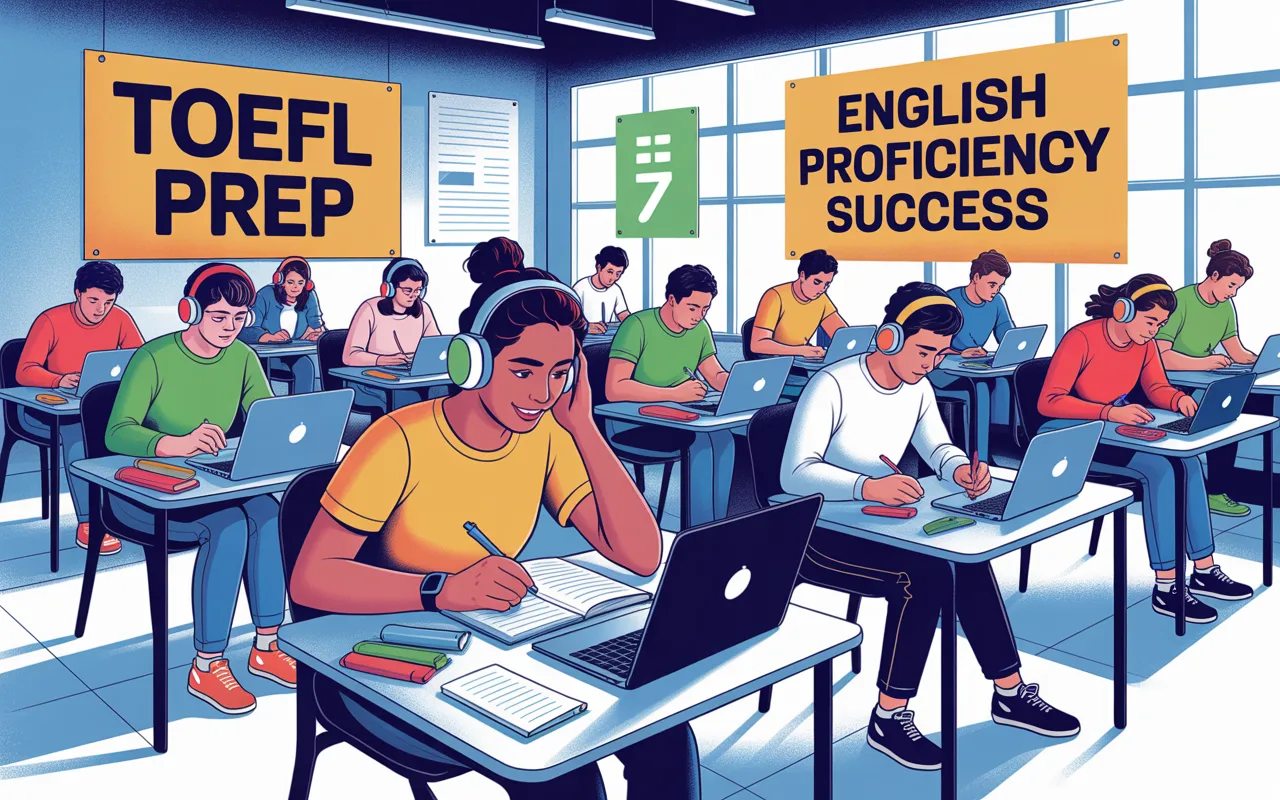
If you’re an English learner, there’s a good chance the word TOEFL has already floated into your life like a tiny cloud of stress. Maybe a teacher mentioned it. Maybe you saw it on a university application page. Maybe someone casually said, “Oh, you’ll probably need a TOEFL score,” as if they were suggesting you bring an umbrella.
I’m here to make this feel a lot less mysterious.
Because the TOEFL is a big deal, yes. But it’s also just a test. A very specific, very learnable, very beatable test. And once you understand what it’s actually measuring, it gets much less scary and much more manageable.
The TOEFL iBT is an English proficiency exam used by universities and institutions around the world to see whether students can handle academic English in real-life situations like lectures, discussions, reading assignments, and writing tasks. ETS says TOEFL scores are accepted by more than 13,000 institutions across 160+ countries, which is why the test shows up so often in study-abroad plans.
First, what does TOEFL even mean?
TOEFL stands for Test of English as a Foreign Language. That sounds very official and slightly intimidating, but the basic idea is simple: it checks how well you can read, listen, speak, and write in academic English.
This is one of the reasons students often find the TOEFL different from casual English-learning apps or school worksheets. It isn’t testing whether you can order coffee or introduce yourself at a party. It’s testing whether you can understand a classroom lecture, respond to a discussion prompt, summarize a reading, or explain an idea clearly in writing. ETS describes the TOEFL as measuring the English skills you’ll actually use in lectures, research, and class discussions.
Why students take the TOEFL
Most students take the TOEFL because they want to study in an English-speaking university or in an international program that uses English. It can also be useful for scholarships, visa requirements in some cases, or proving language ability for certain schools and professional programs. The official TOEFL destinations search exists for exactly this reason: students need to check which institutions accept TOEFL scores and what score range they expect.
And this is where I always tell students to pause for a second and do the boring but important thing: check your specific school first. Not every school wants the same score. Not every school accepts the same formats. Not every program has the same expectations. One university may be perfectly happy with your result, while another wants something much higher. So before you panic-study for six months, make sure you know what target you’re actually aiming for.
What’s on the TOEFL?
The TOEFL iBT has four parts: Reading, Listening, Speaking, and Writing. In other words, all the things English learners usually worry about, gathered into one exam like an academic boss battle.
The Reading section checks whether you can understand academic passages and answer questions about main ideas, details, vocabulary, and structure. The Listening section focuses on lectures and conversations, which means you need to pay attention to both content and tone. The Speaking section asks you to respond out loud to prompts, sometimes using information you just read or heard. And the Writing section asks you to type responses based on reading, listening, and discussion-style tasks. ETS’s official content outline breaks all of this down section by section.
If that sounds like a lot, well… yes. It is. But it’s also very patterned. TOEFL questions are not random. They come in familiar shapes. Once you’ve done enough practice, the test starts to feel less like chaos and more like a routine you know how to handle.
A quick note about the TOEFL scoring change
If you learned about the TOEFL a while ago, you may have heard about the old 0–120 scoring system. As of January 21, 2026, ETS says TOEFL iBT score reports feature a new 1–6 scale, in half-point increments, aligned more clearly with CEFR-style band reporting. During a transition period, ETS has also indicated that students may receive comparable reporting tied to the old scale as well.
This matters because a lot of old blog posts, YouTube videos, and prep books still talk as if nothing changed. So if you are comparing advice from different sources, pay close attention to the date. Otherwise you’ll end up trying to decode two score systems at once, which is a very annoying way to spend an afternoon. ETS’s current score pages are the safest place to confirm what your report will actually look like.
What makes the TOEFL hard?
The hardest part of the TOEFL usually isn’t the English itself. It’s the combination of English + timing + pressure + academic style.
A lot of students can understand English pretty well in normal life, then feel crushed by TOEFL because the test wants them to do several things at once: listen carefully, take notes, remember details, organize ideas quickly, and respond in polished academic language. That’s why the TOEFL can feel exhausting even for strong learners. It’s not just asking, “Do you know English?” It’s asking, “Can you perform English under test conditions?”
And honestly, that’s rude. But at least it’s predictable.
The four skills that matter most
Reading
For TOEFL reading, speed helps, but strategy helps more. You do not need to treat every passage like a sacred literary object. This is not the moment to lovingly admire every sentence. You need to identify structure fast: main idea, supporting details, transitions, author purpose, vocabulary in context.
Students often make the mistake of reading too slowly because they think “careful” means “word-by-word.” It usually doesn’t. Careful means noticing how the passage is built. Once you understand the architecture, the questions get much easier.
Listening
TOEFL listening is where a lot of students start bargaining with the universe. Academic listening is hard because you can’t pause, replay, or ask the speaker to please say that again but more slowly this time. You have to listen once, take notes, and trust yourself.
The good news is that listening improves a lot with exposure. Lectures, interviews, podcasts, and official practice questions all help. ETS offers free listening practice for this reason. You need to train your ear to catch structure, not just vocabulary. Listen for contrast, examples, conclusions, and changes in attitude.
Speaking
This is the part that makes many students spiral. And I get it. Speaking into a microphone with a timer running is not how normal humans like to communicate.
But TOEFL speaking is not really about sounding perfect or charming or deeply philosophical. It’s about sounding clear, organized, and understandable. A student with imperfect grammar but strong structure often does better than a student with fancy vocabulary who rambles into the void.
So if speaking is your weak point, stop aiming for brilliance. Aim for control. Learn a few reliable response structures. Practice summarizing quickly. Record yourself. Listen back. Yes, it’s awkward. Do it anyway.
ETS also notes that Speaking and Writing responses involve both AI scoring and ETS-certified human raters in the scoring process, which is another reason clarity and consistency matter so much.
Writing
TOEFL writing is where students either overcomplicate everything or panic and produce a very polite disaster.
The writing tasks are not asking you to be poetic. They are not asking for your soul. They are asking whether you can organize information, support a point, and write in reasonably accurate academic English. Clean structure matters more than fancy phrasing. Clear ideas beat dramatic vocabulary every time.
And this is why preparation helps so much. Writing gets easier when you stop treating every essay like a fresh existential crisis and start using dependable structures you’ve practiced before.
So how should you actually prepare?
This is where students often get lost, because the internet is full of magical promises. “Boost your TOEFL in three days!” “Memorize these secret templates!” “Get a high score without studying!” Absolutely not. The official ETS bulletin itself even warns against materials claiming to prepare people for the test in a very short time.
Real TOEFL preparation is less glamorous, but it works.
Start with official materials whenever possible. ETS offers test prep resources, free practice questions, full-length practice tests, and preparation platforms because those are the closest match to the real thing.
Then build a realistic plan:
- practice a little every day instead of cramming
- rotate through all four skills so one weak area doesn’t sneak up and ruin your score
- do timed practice regularly
- review mistakes instead of just collecting more practice questions
- keep a notebook of common speaking and writing structures
- read and listen to academic English often, not just test materials
That last point matters more than students think. TOEFL prep is not only about TOEFL prep. It’s also about becoming more comfortable with the kind of English the test uses.
Official TOEFL resources are your safest bet
I know students love shortcuts. I also know a lot of random websites love pretending they are official when they are very much not. So here is the gentle reminder: if you want the most trustworthy prep, go to ETS first.
ETS provides:
- official test prep pages
- free practice questions
- full-length practice tests
- score guidance
- institution search tools
That doesn’t mean every unofficial resource is bad. It just means you should build your foundation on the official material before wandering into the wild forest of “expert hacks.”
Test center or home edition?
Some students also wonder whether the TOEFL Home Edition is accepted. ETS says the Home Edition is the same TOEFL iBT test and that nearly all universities that use the TOEFL accept scores from both the test center version and the Home Edition, although not every institution does. Which means, once again: check your school. Always check your school.
A few things students get wrong about the TOEFL
One: they think they need perfect English. You don’t. You need functional, organized, test-ready English.
Two: they think if they know lots of vocabulary, they’re fine. Vocabulary helps, obviously, but structure and timing are just as important.
Three: they think the best way to improve is to do endless random practice tests. It isn’t. Improvement usually comes from targeted work on your weak spots.
Four: they think one bad practice score means they’re doomed. Also no. Early practice scores are often messy and discouraging. That’s normal. TOEFL prep is one of those deeply annoying processes where you often improve gradually, then suddenly.
If you feel stuck, that’s normal
A lot of English learners carry around a quiet shame about tests like TOEFL. They feel like their score is somehow a judgment on their intelligence, their future, their worth, their ability to belong in an English-speaking academic world.
It isn’t.
The TOEFL measures a specific kind of performance on a specific day in a specific format. That’s all. Some students are brilliant thinkers and awkward test-takers. Some are great in conversation but weak in academic writing. Some freeze under time pressure and then sound amazing the next day. The test matters, yes. But it is not your whole story.
And finally
The best way to think about the TOEFL is not as a monster guarding the gate to your future, but as a weird academic obstacle course. You can train for it. You can get better at it. You can absolutely learn how it works.
So if you’re preparing right now, breathe. Start with official resources. Learn the format. Practice regularly. Don’t chase fake shortcuts. And remember that the goal isn’t to become some flawless English robot. The goal is to show, clearly and confidently, that you can handle English in a real academic setting.
That’s it.
Annoying? Yes. Impossible? Not even close.